
Bloom's Taxonomy Assessment Questions: Examples for Every Level
Most tests measure one thing: memory. Ask learners to recall a definition and you'll know who remembers it — but not who can use it. Bloom's taxonomy gives you a simple structure for writing assessment questions that measure deeper thinking.
What is Bloom's taxonomy?
Bloom's taxonomy is a framework that orders thinking skills from basic to complex. The revised version uses six levels: remember, understand, apply, analyze, evaluate and create. A balanced assessment includes questions across several levels, so you can see where each learner's understanding stops.
Bloom's taxonomy question examples by level
1. Remember
Recall facts and basic concepts.
Stems: Define… List… What is…?
Example: What does GDPR stand for?
2. Understand
Explain ideas in your own words.
Stems: Explain… Summarize… Which best describes…?
Example: Which statement best describes the purpose of a data retention policy?
3. Apply
Use knowledge in a new situation.
Stems: What would you do if… How would you use…?
Example: A customer emails asking you to delete their data. What is your first step?
4. Analyze
Break information into parts and find relationships.
Stems: What is the cause of… Compare… What evidence supports…?
Example: Two teams report the same incident differently. Which details reveal the root cause?
5. Evaluate
Justify a decision or judge quality.
Stems: Which is the best option and why… Assess…
Example: Which of three vendor contracts carries the lowest compliance risk, and why?
6. Create
Produce something new from what you know.
Stems: Design… Propose… Develop a plan…
Example: Draft a one-page process for handling data access requests in your team.
How to balance a Bloom's taxonomy assessment
- Onboarding and foundations: weight toward remember and understand.
- Role readiness and compliance: emphasize apply and analyze with scenarios.
- Leadership and certification: include evaluate and create, often with essay or rubric-scored responses.
Mixing levels in one exam — sometimes called taxonomy stacking — shows not just a score, but a profile: a learner may recall every rule and still struggle to apply them.
Let AI write the first draft
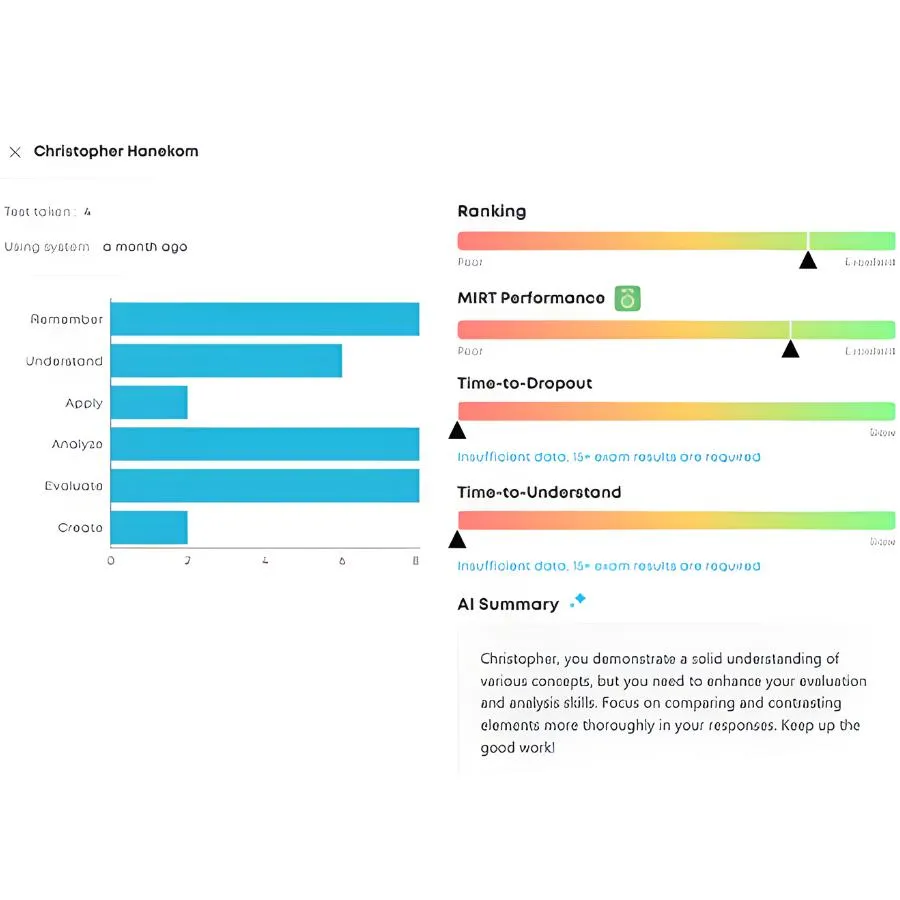
Writing questions at six levels by hand is slow. Quizitive generates questions across Bloom's levels directly from your documents, videos and rubrics, then reports results by level so you can see exactly where learning breaks down. See how educators use it.
Key takeaway
If every question starts with "what is," you're measuring memory. Use Bloom's taxonomy to test whether people can actually think with what they've learned.
Written by
Want to see how verified skills data changes workforce decisions?
Download the full report:
Beyond the Job Title — The Rise of the Skills-First Organization
FAQ's
The revised Bloom's taxonomy has six levels: remember, understand, apply, analyze, evaluate and create, ordered from basic to complex thinking.
Start with level-specific stems such as define for remember, explain for understand, what would you do for apply, compare for analyze, justify for evaluate and design for create, then ground them in realistic scenarios.
Yes. Scenario-based multiple-choice questions can test application and analysis. Evaluate and create levels are often better served by essay or rubric-scored responses.
It ensures tests measure more than memory, revealing whether learners can apply, analyze and evaluate what they learned.
Yes. Platforms like Quizitive generate questions across Bloom's levels from your source material and report results by level.